Tiegh. 1867
What is Aspergillus niger?
Aspergillus niger is one of the most important molds used in biotechnology. Under the FDA, it has a status of “generally regarded as safe”, and it’s been in use for many decades in the production of citric acid and other food-related enzymes.
A. niger is a filamentous, aerobic, and ubiquitous saprobic species, most often found in litter, compost, and decaying plant material. It is generally considered as a non-pathogenic aspergillus, infecting only immunocompromised individuals and occasionally acting as a would pathogen. It can produce mycotoxins only under certain conditions.
Aspergillus niger taxonomy
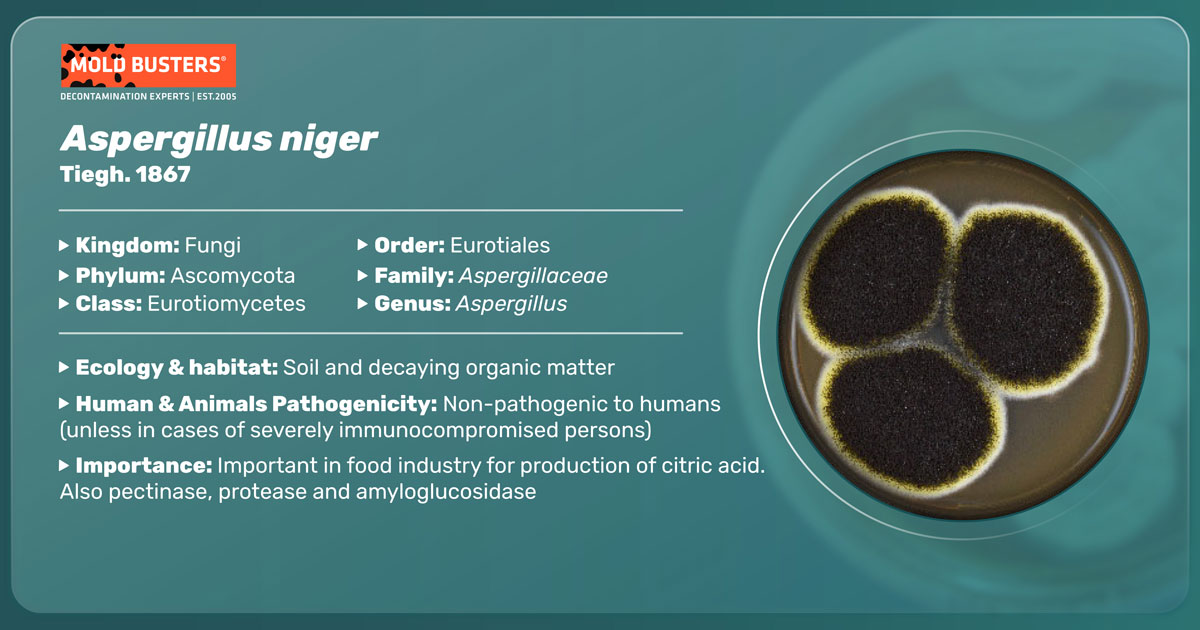
Aspergillus niger belongs to the black aspergilli group (Aspergillus subgenus Circumdati section Nigri). This section is comprised of 18 species, of which A. niger, A. tubingensis, A. brasiliensis, A. acidus, A. carbonarius, and A. ibericus are widespread, while the remaining aspergilli are concentrated mainly in tropical regions (1).
Where can Aspergillus niger be found?
A. niger is one of the most common species of the genus Aspergillus. It is ubiquitous in soil and commonly isolated from indoor environments. It is a frequent contaminant of foods and causes a disease named “black mold” on plants, fruits, and vegetables such as grapes, apricots, onions, and peanuts. Due to its production of black colonies, it is often confused with Stachybotrys, which is also often referred to as the “black mold“.
Aspergillus niger is resilient and can grow under a wide temperature range. Growing temperature is between 6–47°C (42–116°F) with a high optimum ranging between 35–37°C (95–99°F). The minimum required media water activity for growth is aw= 0.77–0.88, coming relatively high in comparison to other aspergilli. A. niger can grow under very wide pH conditions, ranging from 1.4–9.8. Its adaptability for a wide range of ecological conditions, and its ample production of airborne spores, which are distributed via the air, gives the ability to A. niger to be frequent worldwide, especially in warm and humid places. Indoors, it can often be found on damp walls and in areas with significant moisture, such as bathrooms, basements, and kitchens. It can be found in household dust and also on fruits, cereals, and other organic matter (2).
What does Aspergillus niger look like?
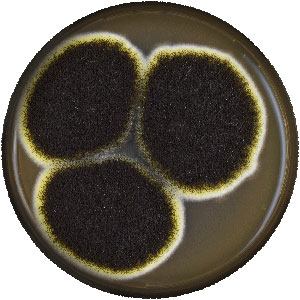
Aspergillus niger produces large colonies, min 60mm (2.3 inches) in diameter, which outgrow Petri dish relatively fast. The colony is made of plain, white mycelium, above which a layer of closely packed, black to dark-brown conidial heads roughly 2–3 mm high is formed (Fig. 1). This dark layer gives the A. niger its distinctive look and scientific name (“niger” is dark in Latin), as the species usually doesn’t produce any other colors when grown (2,3).

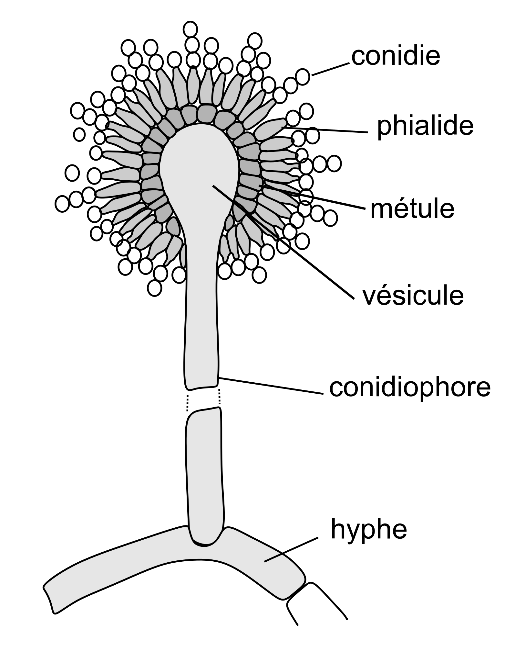
Conidiophores (asexual spore-bearing structures) are formed from the surface hyphae, 1.0–3.0 µm long, with heavy, hyaline (translucent), smooth walls. The vesicles are roughly spherical, 50–75 µm in diameter. A. niger is biserrate and bears closely packed metulae (10–15 µm long) and phialides (7–10 µm long), which cover the whole vesicle surface. The conidia (asexual spores) are spherical, 4–5 µm in diameter, brown, with rough or striate walls (2) (Fig. 2).

How is Aspergillus niger used?
When citric acid was originally produced by fermentation in 1919, A. niger became an industrially used organism. Since then, and still today, citric acid is almost completely produced by A. niger (and A. wentii) fermentation, as it is safe and produced in sufficient amounts. The United States Food and Drugs Administration (FDA) gave A. niger GRAS status (Generally Regarded As Safe), provided that only non-pathogenic and non-toxigenic strains be used in the production processes (4,5).
Citric acid is the primary acidulant in the food and beverage industries. Acidulants are compounds that confer a tart, sour, or acidic flavor to foods, they enhance the perceived sweetness, can act as emulsifiers, and alter the pH levels. Citric acid is used in food products such as soft drinks and fruit juices, wines, desserts jellies and jams, candy. In the medical and pharmaceutical industry, citric acid and citrates are used for the preservation and storage of donated blood. For cosmetics products, it serves as a buffer, for pH levels adjustment, and as an anti-oxidant. Citric acid is also used for the production of detergents and leather tanning (5,6).
Is Aspergillus niger dangerous?
For most people in a normal household, no. Aspergillus niger is considered generally non-pathogenic and non-toxigenic, and it is one of the most common moulds in the world. People breathe its spores every day without any effect, and the FDA classes it as generally regarded as safe for use in food production.
That said, finding it growing indoors still matters. Visible A. niger growth means a surface has been damp long enough for a colony to establish, and the same conditions support species that are more of a concern. Reactions also vary from person to person, and people with allergies, asthma, or weakened immune systems tend to be more sensitive.
Healthy people inhale Aspergillus niger spores without any problem, because the immune system is well equipped to clear them. Neutrophils, a type of white blood cell, deal with fungal spores that reach the lungs (7).
Aspergillosis is a medical condition associated with Aspergillus species, and it is documented mainly in people whose immune systems are already significantly compromised. A. niger-induced aspergillosis is rare. It is reported somewhat more often among horticulturists and others regularly exposed to peat dust and plant material, which can carry high spore loads (5,8,9).
If you are experiencing symptoms you think may be related to mould in your home, that is a conversation for a physician. What we can tell you is whether the mould is there, which species it is, and where the moisture feeding it is coming from.
A. niger strains generally produce a number of safe secondary metabolites, with only ochratoxin A can be regarded as a nephrotoxic and carcinogenic mycotoxin. However, only 3–10% of the examined A. niger strains have tested positive for the production of ochratoxin A, and only under favorable conditions (5,10).
A. niger is one of the species isolated in otomycosis, a fungal condition of the outer ear canal that is most commonly reported in tropical climates, where it accounts for roughly 5% of cases. Even there, the species is generally considered a secondary coloniser rather than the original cause, since most reported patients had been treated with antibiotics before it was isolated (5,11). It is not a condition associated with ordinary indoor exposure in Canadian homes.
Aspergillus niger mold statistics
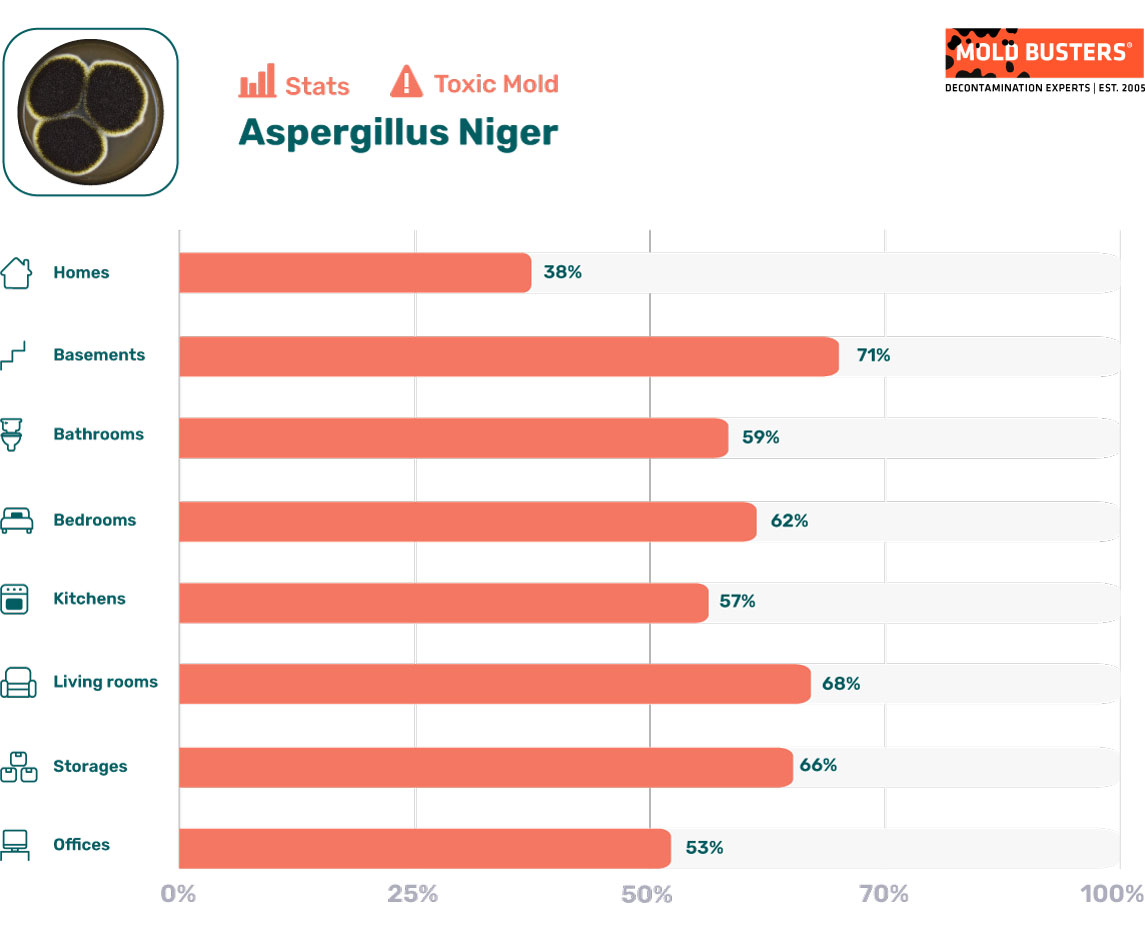
As part of the data analysis presented inside our mold statistics resource page, we have calculated how often mold spore types appear in different parts of the indoor environment when mold levels are elevated. Below are the stats for Aspergillus niger:

How to identify Aspergillus niger in your home?
If you have a spot of mold but aren’t sure if it’s Aspergillus niger, calling a professional mold inspection company may be the best way forward. While Aspergillus niger is considered safe, it can easily be confused with other types of mold and various Aspergillus species, which are considerably more dangerous.
How to get rid of Aspergillus niger?
While home remedies are usually effective, larger or deeper Aspergillus niger infestations can be quite persistent and are best left for mold removal professionals. Call Mold Busters today to schedule an appointment.
Aspergillus niger FAQ
Is Aspergillus niger dangerous?
For most people in a normal household, no. Aspergillus niger is considered generally non-pathogenic and non-toxigenic, and people breathe its spores every day without any effect. Reactions vary from person to person, and people with allergies, asthma, or weakened immune systems tend to be more sensitive. Finding it growing indoors still matters, because visible growth means a surface has been damp long enough for a colony to establish. If you are experiencing symptoms you think relate to mold exposure, speak with a physician.
What does Aspergillus niger look like?
Colonies have a white or pale underlayer with a dense black to dark brown surface, giving a salt and pepper or sooty appearance up close. The black layer is the spore heads, which is where the name comes from, since niger means dark in Latin. Indoors it usually shows up as a flat black patch on a damp surface rather than the fuzzy growth people expect from mold.
Is Aspergillus niger the same as black mold?
No, although it is often called that. Black mold in everyday use usually means Stachybotrys chartarum, which is a different species with different growth requirements. A. niger also produces black colonies and the two are regularly confused by eye. They cannot be told apart reliably without testing, which is one of the main reasons to have a sample identified rather than guessing from a photo.
Where does Aspergillus niger grow in a house?
Anywhere with sustained moisture. Damp walls, bathrooms, basements, and kitchens are the usual places, and it also turns up in household dust and on stored fruit, onions, and cereals. It tolerates a very wide range of temperature and pH, which is part of why it is one of the most common molds worldwide.
How do you get rid of Aspergillus niger?
The moisture source is corrected first, otherwise the growth returns. Small surface patches on non-porous materials can often be cleaned. Larger or deeper growth, and anything on porous material such as drywall or insulation, is usually removed rather than cleaned. The work area is contained and HEPA filtered so spores are not spread through the rest of the building during removal.
References
- Nielsen, K. F., Mogensen, J. M., Johansen, M., Larsen, T. O., & Frisvad, J. C. (2009). Review of secondary metabolites and mycotoxins from the Aspergillus niger group. Analytical and bioanalytical chemistry, 395(5), 1225-1242.
- Pitt JI, Hocking AD. The Ecology of Fungal Food Spoilage. In: Fungi and Food Spoilage
- Aspergillus niger- An Overview – Mycology – Microbe Notes [Internet]. [cited 2021 Nov 8]. Available from: microbenotes.com
- Cairns, T. C., Nai, C., & Meyer, V. (2018). How a fungus shapes biotechnology: 100 years of Aspergillus niger research. Fungal biology and biotechnology, 5(1), 1-14.
- Schuster, E., Dunn-Coleman, N., Frisvad, J. C., & Van Dijck, P. W. (2002). On the safety of Aspergillus niger–a review. Applied microbiology and biotechnology, 59(4), 426-435.
- Max, B., Salgado, J. M., Rodríguez, N., Cortés, S., Converti, A., & Domínguez, J. M. (2010). Biotechnological production of citric acid. Brazilian journal of Microbiology, 41(4), 862-875.
- Thornton, C. R. (2020). Detection of the ‘Big Five’mold killers of humans: aspergillus, fusarium, lomentospora, scedosporium and mucormycetes. Advances in applied microbiology, 110, 1-61.
- Where Aspergillosis Comes From | Aspergillosis | Types of Fungal Diseases | Fungal Diseases | CDC [Internet]. [cited 2021 Oct 22]. Available from: cdc.gov
- Person, A. K., Chudgar, S. M., Norton, B. L., Tong, B. C., & Stout, J. E. (2010). Aspergillus niger: an unusual cause of invasive pulmonary aspergillosis. Journal of Medical Microbiology, 59(Pt 7), 834.
- Abarca, M. L., Bragulat, M. R., Castella, G., & Cabanes, F. J. (1994). Ochratoxin A production by strains of Aspergillus niger var. niger. Applied and environmental microbiology, 60(7), 2650-2652.
- Ibekwe, A. O., & Okafor, J. I. (1983). Pathogenic organisms in chronic suppurative otitis media in Enugu, Nigeria. Tropical and geographical medicine, 35(4), 389-391.
Get Special Gift: Industry-Standard Mold Removal Guidelines
Download the industry-standard guidelines that Mold Busters use in their own mold removal services, including news, tips and special offers:

Written by:
Dusan Sadikovic
Mycologist – MSc, PhD
Mold Busters
Fact checked by:
Michael Golubev
General Manager
Mold Busters