Link 1809
What is Penicillium?
With over 300 accepted species, the Penicillium genus includes some of the most frequently isolated molds in the world. Penicilli (the common name given to fungi from this genus) are saprophytic fungi common in soil, on decaying plant debris, compost, grains, and rotting fruit. Indoors, they can be found on wallpaper and house fabrics, house dust, and water-damaged buildings in general. (1,2)
Penicillium fungi are common allergens, triggering such reactions as hypersensitivity pneumonitis and hay fever. It can also exacerbate asthma symptoms.
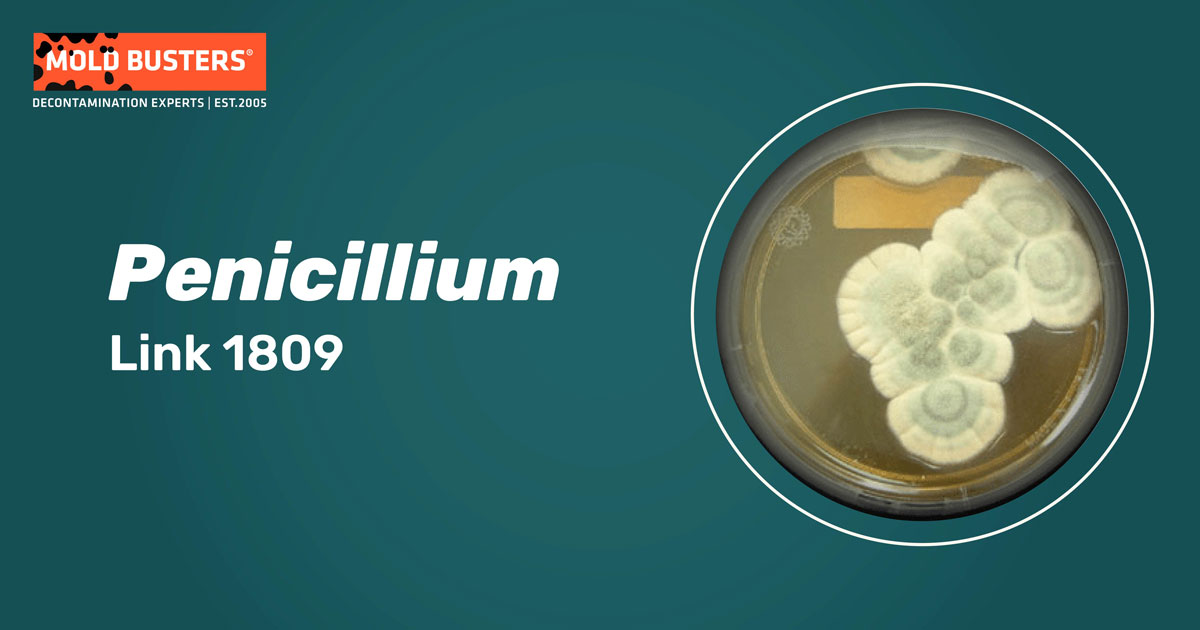
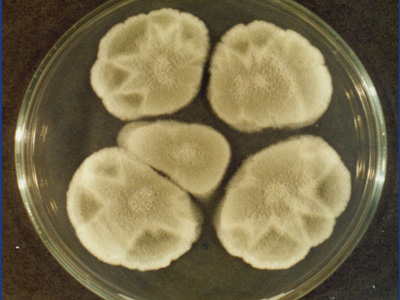
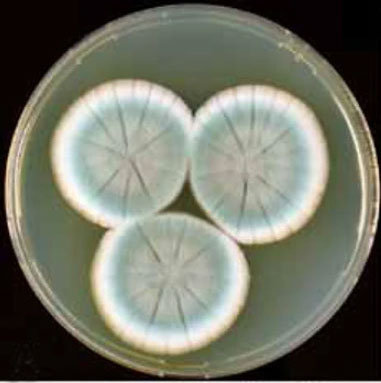
While Penicillium is typically non-pathogenic, there are a few exceptions. Some Penicillium species are capable of producing microbial volatile organic compounds (MVOCs) and toxins that can be harmful, especially upon long-term exposure. Their colonies range from blue-green to white, yellow, and pink with a velvety or powdery texture, and due to the production of MVOCs, some release a strong, musty odor. However, fungi from the Penicillium genus are also the source of the first produced antibiotic – penicillin (3,4).
Who discovered Penicillium?
Penicillin was discovered in 1928 by Dr. Alexander Fleming, who was a physician and bacteriologist at St. Mary’s Hospital in London, England. He was culturing Staphylococcus bacteria strains and one day noted that some of his bacteria colonies, left on the working bench, had strange green contaminations. Dr. Fleming realized that the mold, then considered the Penicillium notatum, had prevented the normal growth of Staphylococcus colonies. Today, we know that this organism was P. rubens (5, 6).
.png)
In March 1942, 14 years after the discovery of penicillin, Anne Miller became the first patient to be successfully treated with penicillin after she miscarried and developed an infection that led to blood poisoning and almost took her life at New Haven Hospital, Connecticut. (6)
At that time, no specified medications for bacterial infections existed, and many people developed blood poisoning. In addition to being the first person to suggest that Penicillium mold is capable of secreting an antibacterial substance, Dr. Fleming was also the first person to develop a concentrate of the active substance, penicillin, in 1928.
Dr. Fleming realized that the microbial inhibiting factor can be used in combating the causes of diseases such as scarlet fever, pneumonia, meningitis, diphtheria, and an important sexually transmitted disease of that time – gonorrhea. A lot of research was conducted over the next twelve years, during which he grew and distributed the original mold. Penicillin was introduced as an antibiotic 1940s during the Second World War, and since then, it has been recognized as one of the greatest advances in therapeutic medicine (6, 7).
Common species of Penicillium
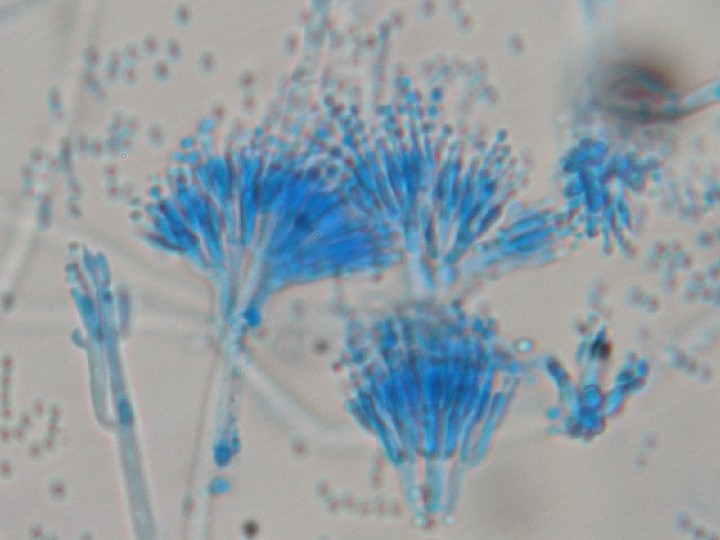
The name Penicillium was derived from the fact that their conidiophores (asexual spores-bearing structures) have a close resemblance to a paintbrush (“penicillus” means painter’s brush in Latin). Today, there are over 300 accepted species of Penicillium.
Some of the most ubiquitous Penicillium species include P. chrysogenum (syn. P. notatum), P. purpurogenum, P. janthinellum, P. digitatum, and P. marneffei (syn. Talaromyces marneffei). The identification of some of these species can be based on their microscopic features and macroscopic colony morphology, but with some closely related species, molecular identification is more reliable (8, 9).
.jpg)
What is Penicillium mold?
Where can Penicillium be found?
Penicillium can be found practically anywhere, from air to soil and our homes. They can also grow on leather and textile items and are a strong indicator of indoor excess moisture. Like most other molds, If there is enough moisture and required temperature, Penicillium will grow. Fungi from this genus compete with genera such as Aspergillus and Fusarium.
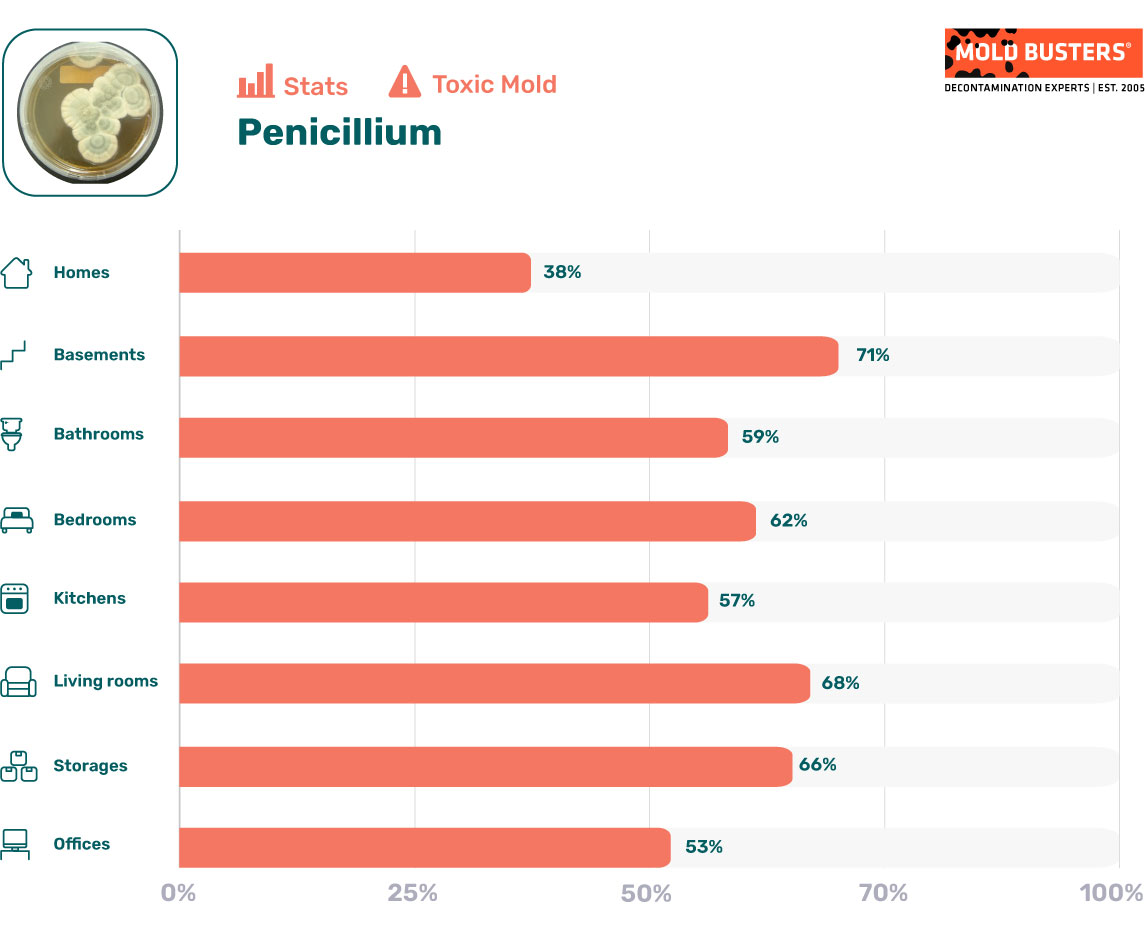
Penicillium mold statistics
The following results represent a part of our statistical analysis that describes mold infestations in common households. We tried to answer questions such as “Most common toxic mold types found in homes” or “Stats about mold types found in bedrooms“, and many more. For a more detailed analysis, please visit our Mold Statistics page.

Are Penicillium molds dangerous?
As frequent agents of food spoilage, Penicillium molds can be hazardous to human health. This is because some species of Penicillium produce toxic compounds known as mycotoxins (10). More than thirty different toxic compounds have been isolated from Penicillium ssp. contaminated foods, both human and animal (11). It is, therefore, better to be safe than sorry and discard any food items showing signs of mold growth.
Furthermore, inhalation of Penicillium spores can trigger allergic reactions in individuals who are sensitive to mold. As such, indoor environments containing high concentrations of Penicillium spores can trigger various health issues, ranging from mild irritation to asthmatic episodes.
What are safe levels of Penicillium?
The Environmental Relative Moldiness Index (ERMI) is an indoor air quality testing method developed by the U.S. Environmental Protection Agency and the U.S. Department of Housing and Urban Development. It was designed as a reliable, standardized method to evaluate air quality and mold contamination of U.S. homes.
ERMI uses DNA-based technology to assess which dangerous mold species associated with water damage are present in tested households. It also tests the amounts of mold material (spores and hyphal fragments). ERMI also tests for certain mold species not connected with water-damaged homes but are also known to have adverse health effects. It can also give a value of their quantity.
Of the thirty-six mould species on the ERMI list, seven belong to the Penicillium genus: Penicillium brevicompactum, P. corylophilum, P. crustosum, P. purpurogenum, P. spinulosum, P. variabile, and P. chrysogenum. Reported reactions to these species are mainly respiratory and allergic, and sensitivity varies from person to person (12).
What are the allergy symptoms associated with Penicillium mold?
Penicillium and most molds are prolific spore producers. These spores are released into the air and deposited on all household surfaces or linger in the air, where we can inhale them. Furthermore, spores are resistant to the lack of moisture and can survive in a dry state for many years (13). How each person reacts to the inhalation of Penicillium mold spores is unique. Some individuals may experience asthma symptoms or allergic reactions, while others may not feel anything. There is also the matter of cross-reactivity, where certain fungal proteins of non-allergenic species may trigger anaphylactic reactions due to structural similarities with Penicillium species (14).
We inhale thousands of fungal spores every day, and the immune system clears them without incident. In people prone to allergies, these spores can trigger a hypersensitive response. If you are allergic to Penicillium, that typically shows up as itchy or watery eyes, sneezing, nasal congestion, and irritation of the lips, mouth, and nose. How strongly any individual reacts varies widely, and a physician is the right person to assess an allergy rather than a website.
What are the health effects of Penicillium mold?
Some Penicillium species produce mycotoxins, including ochratoxin A, citrinin, patulin, and penitrem. Production varies enormously between species and conditions, from trace amounts to none at all, and a species being capable of producing a mycotoxin does not mean a given colony is producing one.
Most of what is known about the effects of these compounds comes from studies of dietary exposure, meaning eating contaminated food, rather than from breathing spores in a building. That distinction matters for a homeowner: the practical response to Penicillium growing indoors is to remove it and correct the moisture, not to try to assess a toxin dose (15).
How to remove Penicillium mold?
Any mould growing indoors should be removed, and sooner is better than later, because a colony that is left alone keeps spreading as long as the moisture supporting it is there. People react to indoor mould differently, and infants, older adults, people with asthma or other respiratory conditions, and people with weakened immune systems tend to be more sensitive than others.
To protect your health as well as the health of your family, removing mold from your indoor environment quickly and effectively is essential.
When cleaning mold, you should avoid exposing yourself to mold spores and mycotoxins. This is the reason why many homeowners decide to hire a mold removal professional to safely eliminate the mold problem. However, if you choose to do the mold removal work yourself, you must protect yourself with the appropriate safety equipment and follow established containment, remediation, and waste disposal procedures.
The following is a list of the personal protective equipment you should wear when cleaning mold:
- N-99 or N-95 respiratory mask
- Full-body suits
- Safety goggles
- Disposable shoe covers
- Disposable gloves
How to prevent Penicillium mold from growing back?
Once you have removed all Penicillium molds from your home, you need to prevent them from growing back. Since mold spores are airborne, your home should be well ventilated with plenty of air circulation. This will reduce dampness and humidity, which are the key factor in any mold contamination. Using an air purifier and/or dehumidifier will also help reduce the relative humidity inside your home.
For persistent mold infestations, you should contact a mold removal professional. At Mold Busters, our diagnostic mold inspections and visual assessments often reveal hidden moisture problems that contribute to ongoing mold contamination and decreased indoor air quality inside of homes.
Call us today to book your mold inspection.
Penicillium FAQ
Is Penicillium mold dangerous?
Penicillium is typically non-pathogenic, and it is one of the most common molds found in homes worldwide. The realistic effect for most people is allergic: sneezing, congestion, itchy eyes, and aggravated asthma in those who are sensitive, varying considerably from person to person. Some species can produce mycotoxins, though most of what is known about their effects comes from dietary exposure rather than from breathing spores indoors. Finding it growing in your home still matters, because it means a surface has stayed damp. If you are experiencing symptoms you think relate to mold exposure, speak with a physician.
What does Penicillium mold look like?
Most often blue green, with a velvety or powdery surface, though colonies can also be white, yellow, or pink depending on species and age. The texture is the most recognisable feature: a flat, dusty looking patch rather than the raised fuzz of faster growing molds. Many species also give off a strong musty smell, which is frequently the first thing people notice before they see anything.
Where does Penicillium grow in a house?
On wallpaper, carpet, fabrics, insulation, and house dust, and in water damaged buildings generally. It also grows readily on leather and textiles, which is why it turns up in closets and on stored clothing and shoes. It is a strong indicator of excess indoor moisture, so an established colony usually means humidity or a leak rather than a one time spill.
Is Penicillium mold the same as penicillin?
No. Penicillin is an antibiotic that was originally derived from one species in this genus, P. rubens, discovered by Alexander Fleming in 1928. The genus contains over 300 species, and the ones that grow on a damp wall are not the ones used to make medicine, nor do they produce useful quantities of penicillin. Finding Penicillium in your home has no connection to penicillin allergy and is not a source of antibiotics.
How do you get rid of Penicillium mold?
Correct the moisture source first, otherwise the growth returns in the same place. Colonized porous materials such as drywall, insulation, carpet, and fabrics are usually removed rather than cleaned. Hard non-porous surfaces can often be cleaned once the source is fixed. Improving ventilation and lowering indoor humidity with a dehumidifier keeps it from re-establishing. For anything beyond a small surface patch, containment and HEPA filtration keep spores from spreading through the rest of the building during removal.
References
- American academy of allergy asthma & immunology found on site, visited 3/19/2019;
- Burge, H.A., (1985): Fungus allergens, Clin. Rev. Allergy, 3:19-329;
- de Hoog, G. S., J. Guarro, J. Gene, and M. J. Figueras, (2000): Atlas of Clinical Fungi, 2nd ed, vol. 1. Centraalbureau voor Schimmelcultures, Utrecht, The Netherlands;
Fog Nielsen, K. (2003): Mycotoxin production by indoor molds, Fungal Genetics and Biology, 39 (2): 103–17; - Haubrich, W.S. (2003) Medical Meanings: A Glossary of Word Origins, (2nd ed.). Philadelphia, Pennsylvania, American College of Physicians. p. 175;
- Howard Markel (2013): The real story behind penicillin, found on site, visited 3/19/2018;
- Houbraken, J., Frisvad, J. C., & Samson, R. A. (2011). Fleming’s penicillin producing strain is not Penicillium chrysogenum but P. rubens. IMA fungus, 2(1), 87-95.
- International Historic Chemical Landmarks – American Chemical Society, (Retrieved in 2018): Discovery and development of penicillin;
- Kirk, PM; Cannon, PF; Minter, DW; Stalpers, JA., (2008): Dictionary of the Fungi(10th ed.), Wallingford, UK: CABI. p. 505;
- Pasanen A-L., Lappalainen S., Pasanen P., (1996): Volatile organic metabolites associated with some toxic fungi and their mycotox-ins., 121:1949-53;
- A. Jackson, A.D.W. Dobson (2016): Yeasts and Molds: Penicillium camemberti, Reference Module in Food Science;
- Otero, C., Arredondo, C., Echeverría-Vega, A., & Gordillo-Fuenzalida, F. (2020). Penicillium mycotoxins found in food and feed and their health effects. World Mycotoxin Journal, 13(3), 323-343.
- Chowdhary, A., Agarwal, K., & Meis, J. F. (2016). Filamentous fungi in respiratory infections. What lies beyond Aspergillosis and Mucormycosis?. PLoS pathogens, 12(4), e1005491.
- Żukiewicz-Sobczak, W. A. (2013). The role of fungi in allergic diseases. Advances in Dermatology and Allergology/Postȩpy Dermatologii I Alergologii, 30(1), 42.
- Gabriel, M. F., González-Delgado, P., Postigo, I., Fernández, J., Soriano, V., Cueva, B., & Martínez, J. (2015). From respiratory sensitization to food allergy: Anaphylactic reaction after ingestion of mushrooms (Agaricus bisporus). Medical mycology case reports, 8, 14-16.
Get Special Gift: Industry-Standard Mold Removal Guidelines
Download the industry-standard guidelines that Mold Busters use in their own mold removal services, including news, tips and special offers:

Written by:
John Ward
Account Executive
Mold Busters
Edited by:
Dusan Sadikovic
Mycologist – MSc, PhD
Mold Busters