
P. Micheli ex L. 1753
What is Mucor?
Fungi belonging to the genus Mucor are primarily saprophytic and cosmopolitan molds, predominantly found in moist and damp habitats. These fungi are now associated with a polyphyletic but ancient group (phylum) of fungi, Zygomycetes. Polyphyly means that a group of organisms share common characteristics but do not share a common ancestor. It is considered that members of this obsolete species represent one of the most primitive fungal forms, which has diverged very early from the dominant, higher fungi such as Ascomycota and Basidiomycota [1,2,3].
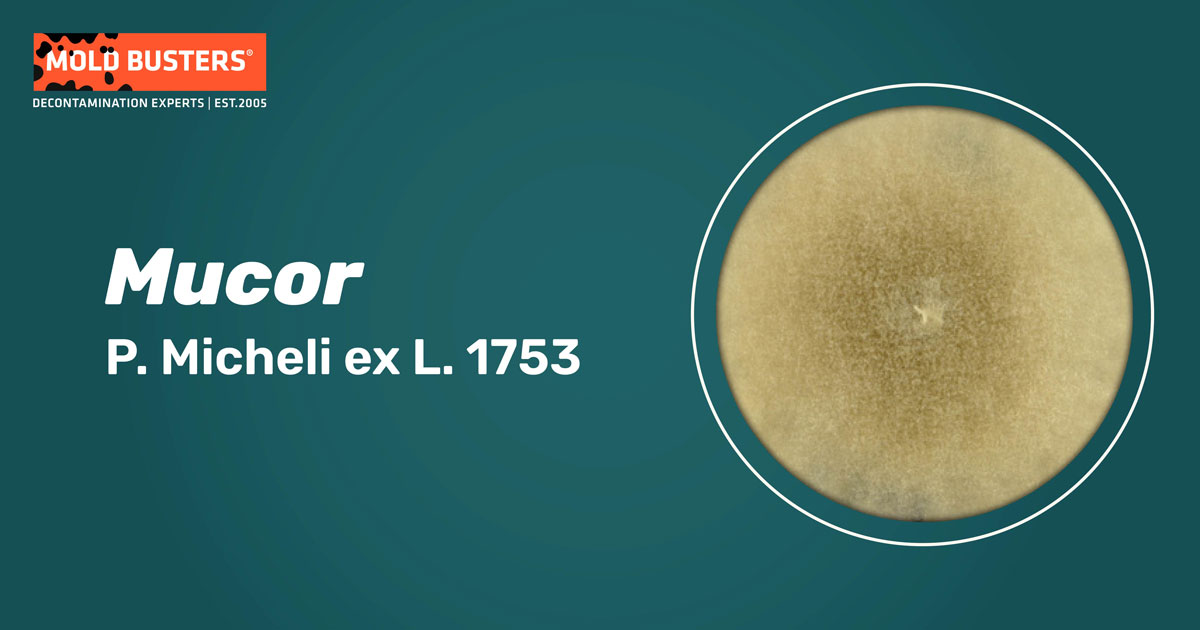
Mucor morphology
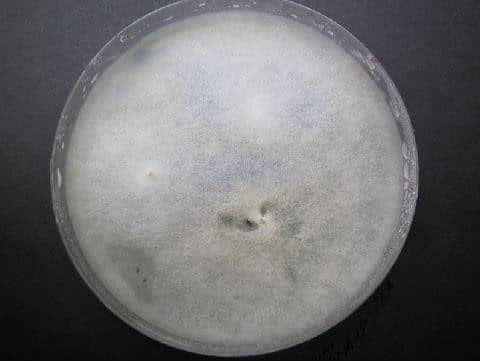
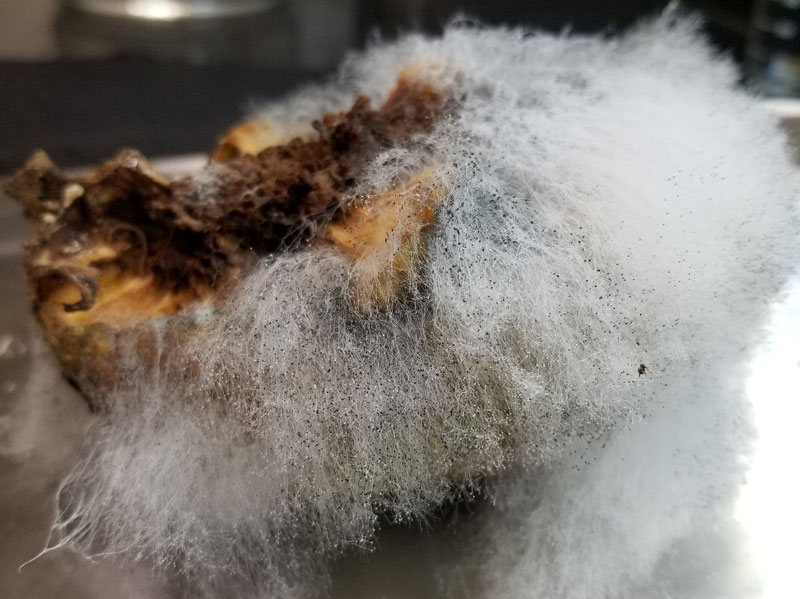
Mucor spp. colonies are typically white, grey to cream-beige. The darker colors of the colony are usually the consequence of maturity and the formation of spores. They are rapid-growing, cottony to fluffy, and can become relatively tall. Cultures grown in culture media readily exceed 1 cm in height (0.4 inches). Mucor spp. colonies consist of white cottony extensively branched mycelium (Fig. 1).
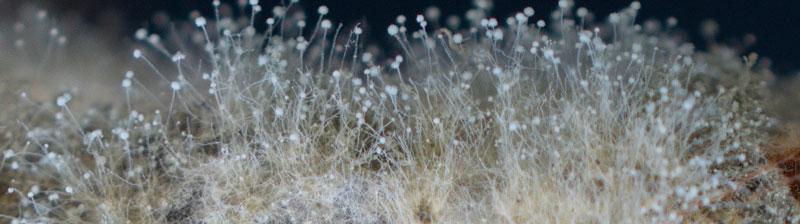
Sporangiospores, a type of asexual spores produced by the Mucor spp., form larger, apical, and globular sporangia. Sporangia are mounted on columnella, supported, and elevated from the rest of the colony by column-shaped structures, sporangiophores (Fig. 2). Sporangiospores are globose, hyaline, gray, or brownish 7-8 µm in diameter [1,2].
Mucor reproduction
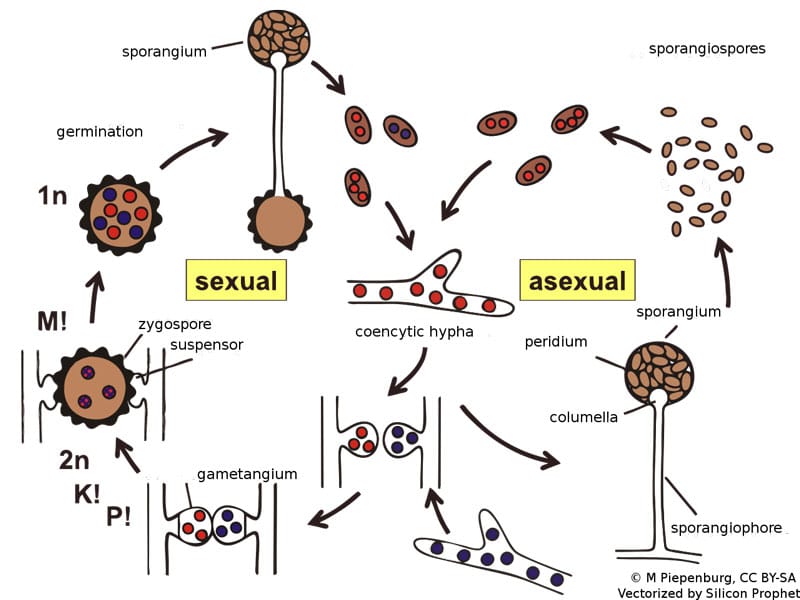
Fungi from the Mucor genus can reproduce both asexually and sexually. Asexual reproduction takes place by the production of sporangiospore, oidia, and chlamydospore, while sexual reproduction is conducted via the formation of zygospores (Fig. 3). This genus has both heterothallic (sexes reside in different individuals) and homothallic (sexes reside in the same individual) species. Mucor spp. can also reproduce vegetatively by fragmentation of the whole mycelium, after which individual fragments can become mother colonies [1,2, 10].
Asexual reproduction
Sporangiophores are nonmotile spores that are formed during favorable conditions. They are formed in the sporangia, which walls burst when spores have matured. Insects and wind disperse the spores. Oidia are formed when the fungus grows on a substrate rich in sugars. They are formed as the hypha breaks up into component cells, from which oidia spores are developed. Initially, they can bud-like yeasts and form mycelium afterward. Oidia also can’t survive unfavorable conditions. On the other hand, chlamydospores are thick-walled, nutrition-rich, mycelium segments that survive harsh conditions. They are produced from the hyphae and are released when the mycelium which connects the chlamydospore segments dries out [1, 10].
Sexual reproduction
Sexual reproduction occurs during unfavorable conditions, and in heterothallic species, it occurs between two compatible (different mating types) strains. When the mycelia of two compatible strains are close, they form gametangia which get fused. The walls of these structures dissolve, fuse, and combine their cell content to form a zygospore. When zygospore matures, it will start to produce meiospores which, when released, can form individual mycelium [10].
Where can be Mucor mold found?
Most species of Mucor have a cosmopolitan distribution. They can be found in soil, plants, decaying fruits and vegetables, stored grains, dairy products, and animal dung (Fig. 4). Indoors, their spores can be found in household dust, contained in carpets, and mattresses, ventilation ducts, and can grow on water-damaged structural material [7]. These spores are inhaled by humans daily but are mostly harmless. Luckily, most species of Mucor can’t grow at 37 °C. However, several thermotolerant species exist and are known to cause opportunistic infections in humans and animals.
What is Mucor infection?
The immune system is well equipped to deal with Mucor spores, which is why everyday exposure to this very common mould does not cause infection in healthy people. Documented human infections are associated almost exclusively with people whose immune defences are already severely compromised [5].
The people affected are those whose immune defences are already substantially weakened, whether by a serious underlying illness or by treatment that suppresses immunity [4]. That is a small and specific group, and it is not the situation of someone who has found mould growing in their home.
The species reported in the medical literature are mainly M. circinelloides, M. indicus, M. ramosissimus, M. irregularis, and M. amphibiorum. M. hiemalis and M. racemosus have also been recorded, though neither grows above 32 °C, which limits them to surface tissue [4]. Most Mucor found in buildings is not one of these species, and the important distinction indoors is between mould that is growing and mould that is not.
Mucormycosis is the collective name for infections caused by moulds in the Mucorales order, which includes Mucor and several other genera. It is a serious medical condition, and it is also a rare one. It develops almost exclusively in people whose immune systems are already severely compromised, whether by an underlying illness or by immune-suppressing treatment [5]. It is not an expected consequence of encountering this mould in a building, and it is not what a patch of Mucor on a damp wall represents.
Medical literature classifies mucormycosis by the part of the body involved, and cases are described in clinical sources such as the mucormycosis overview and the reference material listed below [5]. Describing those disease courses is a matter for medical professionals rather than for a mould inspection company, and the classifications have no bearing on how Mucor growth in a building is assessed or removed. Related genera in the same order, including Aspergillus, are covered elsewhere in this library.
How to identify Mucor mold in your home?
Given a damp surface, Mucor develops into a sporulating colony quickly, which is why it often seems to appear overnight. Airborne spores affect people differently, and those with allergies or asthma tend to notice them first. Look in the damp areas of the house: bathrooms, under sinks, and on any water damaged structural material. Telling one grey white mould from another by eye is unreliable, so professional mold testing is the way to confirm what you actually have.
How to get rid of Mucor mold?
Tackling the mold on your own is rarely a good idea, especially in situations where the mold growth is substantial and well developed. Not only is the mold persistent and difficult to fully eradicate, but by coming into close contact with it, you increase the likeliness of inhaling an excessive number of spores. This can be detrimental to the health of even the fittest person and is usually not worth the risk.
At Mold Busters, we have a proven track record of completely removing any type of mold. Our technicians possess the knowledge, experience, and technology needed to solve any mold-related issue. In addition, we can shed light on any underlying issues that may need to be fixed to ensure that any mold doesn’t reoccur in the future. Call us today to book your appointment.
Mucor FAQ
Is Mucor mold dangerous?
For most people in a normal household, everyday exposure to Mucor spores does not cause infection. Reported reactions are mainly allergic and respiratory, and sensitivity varies from person to person, with people who have asthma or allergies tending to react more readily. Serious Mucor infections are documented but rare, and occur almost exclusively in people who are already severely immunocompromised. If you are experiencing symptoms you think relate to mold exposure, speak with a physician.
What does Mucor mold look like?
It starts as white cottony growth and turns grey to cream beige as it matures and produces spores. It grows tall for a mold, often visibly fluffy within a day or two, with tiny pin like heads on stalks above the surface. That pinhead appearance is why it is commonly called pin mold. On food it is the fast grey fuzz that appears on bread and soft fruit.
Where does Mucor grow in a house?
In consistently damp places: bathrooms, under sinks, around leaks, and on water damaged structural material. It also turns up in household dust, carpets, mattresses, and ventilation ducts, and it is common on spoiled food and stored produce. It needs sustained moisture, so finding an established colony indoors points at a moisture problem rather than ordinary humidity.
Why does Mucor grow so fast?
Mucor is one of the faster growing indoor molds. Colonies can exceed a centimetre in height in culture and spread visibly within a couple of days when moisture and temperature suit it. That speed is useful information: growth that appears suddenly and spreads quickly usually means an active water source rather than a long standing damp patch.
How is Mucor mold removed?
The moisture source is corrected first, otherwise the growth returns. Because Mucor sporulates readily, disturbing an established colony releases spores easily, so the work area is contained and HEPA filtered during removal. Porous materials that are colonized, typically drywall and insulation, are usually removed rather than cleaned. Small patches on hard non-porous surfaces can often be cleaned once the source is fixed.

Did you know?
Chaetomium is the 2nd common toxic mold type found in homes we tested?! Find out more exciting mold stats and facts inside our mold statistics page.
References:
- Morin-Sardin, S., Nodet, P., Coton, E., & Jany, J. L. (2017). Mucor: A Janus-faced fungal genus with human health impact and industrial applications. Fungal Biology Reviews, 31(1), 12-32.
- Krings, M., Taylor, T. N., & Dotzler, N. (2013). Fossil evidence of the zygomycetous fungi. Persoonia: Molecular Phylogeny and Evolution of Fungi, 30, 1.
- Weber RW (2015). Allergen of the month – Mucor. Ann Allergy Asthma Immunol. 115(2): A15.
- Ellis D (2019). Mucor. Retrieved from mycology.adelaide.edu.au.
- Howard DH (2003). Pathogenic Fungi in Humans and Animals. Marcel Dekker, New York. pp 67-121.
- Prakash H, Chakrabarti A (2019). Global Epidemiology of Mucormycosis. J Fungi (Basel). 5(1).
- Andersen B, Frisvad JC, Søndergaard I, Rasmussen IS, Larsen LS (2011). Associations between fungal species and water-damaged building materials. Applied and Environmental Microbiology. 77 (12): 4180–8.
- Centers for Disease Control and Prevention (2015). Symptoms of Mucormycosis. Retrieved from cdc.gov.
- Quan C, Spellberg B (2010). Mucormycosis, pseudallescheriasis, and other uncommon mold infections. Proc Am Thorac Soc. 7(3):210-5.
- Lee, S. C., & Heitman, J. (2014). Sex in the Mucoralean fungi. Mycoses, 57, 18-24.
Get Special Gift: Industry-Standard Mold Removal Guidelines
Download the industry-standard guidelines that Mold Busters use in their own mold removal services, including news, tips and special offers:

Written by:
John Ward
Account Executive
Mold Busters
Fact checked by:
Michael Golubev
General Manager
Mold Busters